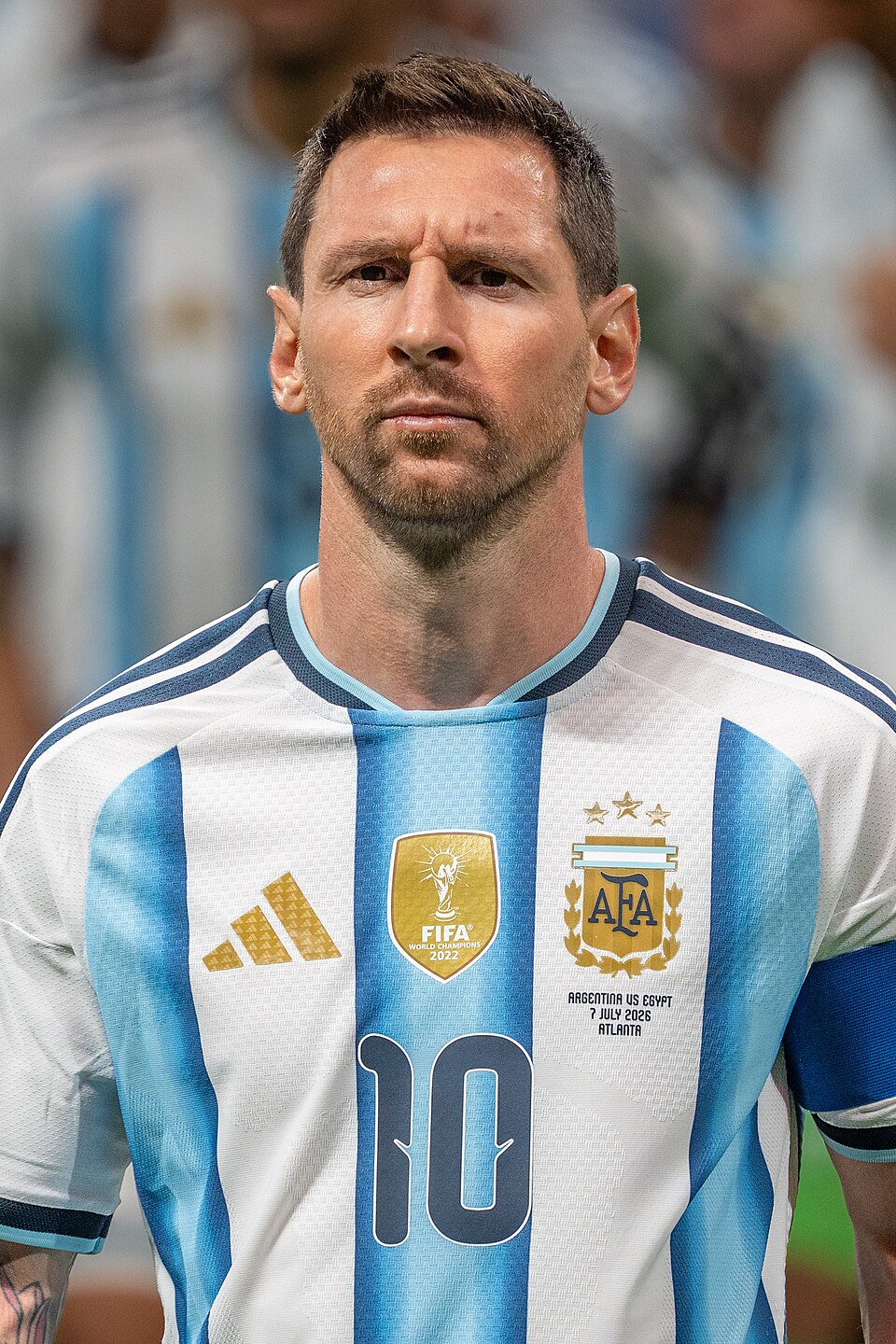
1987–200001A boy from Rosario
Lionel Andrés Messi was born on 24 June 1987 in Rosario, Argentina. Football filled his childhood: he played at Grandoli before joining Newell’s Old Boys. His small stature became part of his story when he was diagnosed with growth hormone deficiency. At thirteen, the opportunity to join Barcelona brought a life-changing move to Spain, separating him from much of the world he knew.
2000–200802Finding his feet in Barcelona
Messi progressed through Barcelona’s youth teams and reserves before making his official first-team debut against Espanyol on 16 October 2004. His first league goal followed in May 2005, from a Ronaldinho assist. Injuries interrupted his early seasons, but his acceleration, close control and fearless dribbling made him increasingly central to the team. The young winger eventually inherited Barcelona’s number 10 shirt.
2008–201503A team—and a player—reimagined
Under Pep Guardiola, Messi became both a prolific scorer and the creative centre of Barcelona’s attack. His role as a “false nine” drew defenders out of position and opened space for teammates. Barcelona won the treble in 2009; another Champions League triumph followed in 2011. Alongside Neymar and Luis Suárez, Messi helped win a second treble in 2015. The success reflected extraordinary individual ability within exceptional teams.
2009–202104Seventeen seasons of records
By the end of his Barcelona career, Messi had scored 672 goals in 778 official appearances and won 35 trophies. His 91 official goals for club and country in 2012 became a landmark of modern football. The numbers capture only part of his influence: he increasingly combined goals with playmaking, drawing opponents toward him before releasing a pass or changing direction at speed.
2005–201605Argentina: promise, pressure and heartbreak
Messi won the 2005 Under-20 World Cup and Olympic gold at Beijing 2008. Senior international success proved harder to reach. Argentina lost the 2014 World Cup final to Germany and the 2015 and 2016 Copa América finals to Chile. After the 2016 defeat he announced his international retirement, then returned. The repeated disappointments made his relationship with the national team one of the defining tensions of his career.
2021–202206The trophy he had chased
Victory at the 2021 Copa América ended Messi’s wait for a major senior international title. At Qatar 2022, Argentina recovered from an opening defeat to reach the final against France. Messi scored twice in a 3–3 draw and converted his shootout penalty as Argentina won. At thirty-five, he lifted the World Cup and received the tournament’s Golden Ball, completing the most celebrated chapter of his international career.
2021–202307An unexpected farewell, then Paris
Messi’s Barcelona chapter ended in 2021. At Paris Saint-Germain he joined an attack featuring Neymar and Kylian Mbappé, won two French league titles and the Trophée des Champions, and adapted to a new club after two decades in Barcelona. PSG’s farewell recorded 74 appearances, 32 goals and 35 assists across his two seasons. The move widened the geography of a career once inseparable from one club.
2023–202408A new continent, a familiar influence
Messi joined Inter Miami in 2023. A stoppage-time free kick on his debut against Cruz Azul announced his arrival, and he led the club to its first trophy, the Leagues Cup. Later that year he received his eighth Ballon d’Or. Argentina retained the Copa América in 2024, adding another title to the international revival that had begun three years earlier.
202609A sixth World Cup
Messi’s international story continued at the 2026 World Cup, his sixth appearance at the tournament. Argentina reached the final again but lost 1–0 to Spain. It added another final—and another disappointment—to a career whose meaning has never rested on one result alone.
Beyond football10Family, roots and giving back
Messi married his childhood acquaintance Antonela Roccuzzo in Rosario in 2017; they have three sons, Thiago, Mateo and Ciro. His public life also includes the Leo Messi Foundation and his role as a UNICEF Goodwill Ambassador since 2010. UNICEF describes his work supporting children’s health and access to opportunities. The family connection to Rosario remains an enduring thread through a life spent largely abroad.
Editorial summary reviewed 6 September 2026. Sources accompany each chapter for further reading.